EN

How Can Buyers Source Bulk Bolts From Manufacturers?
Buying bolts in volume is not simply a matter of finding the lowest unit price. A bulk order can reach a construction site or assembly line months after the original quote, so the useful question is whether the supplied bolts will match the drawing, perform in the stated environment, and arrive with evidence that the receiving team can verify. That is why a disciplined sourcing process matters more than a long catalog.
For international procurement, a bolt manufacturer should receive a clear technical request before price comparisons begin. A capable supplier can quote from a sample or drawing, but vague requests create quotes that cannot be compared fairly. The process below helps buyers turn a need for bulk bolts into a controlled purchase rather than a gamble on a listing.
Start with the application, not the catalog
Catalogs group bolts by form: hex, carriage, flange, lag, structural, and other styles. That is useful for browsing, but it is not a complete purchasing specification. First identify what the joint must do: carry static load, resist vibration, tolerate outdoor moisture, fit a tapped hole, or pair with a nut and washer. The mating parts, access for installation, and maintenance plan all affect the right choice.
A common mistake is to ask for the highest strength class available. Higher strength can be appropriate, but it is not automatically the economical answer. If the connection has modest load but a corrosive environment, material and finish may be more important than a higher mechanical class. If vibration is central, joint design and tightening control deserve attention alongside the bolts themselves.
For carbon-steel and alloy-steel fasteners, ISO 898-1 is commonly consulted for mechanical-property requirements of specified bolts, screws, and studs. Buyers should still state their actual application needs separately: that standard does not, by itself, establish corrosion resistance, torque-to-clamp behavior, or fatigue performance. Treat a standard reference as one part of the specification, not as a substitute for defining the service environment.
Build an RFQ that a bolt manufacturer can answer accurately
An effective RFQ makes competing quotations comparable. Send the drawing when available and put the following details in a line-item table for every size. This gives a bolt supplier less room to make an unspoken assumption.
- Type and dimensions: head style, nominal diameter, overall length, unthreaded grip length, thread length, and any special geometry.
- Thread system: metric or inch series, pitch or threads per inch, tolerance if needed, and whether coarse or fine thread is required.
- Material and class: the requested steel, stainless grade, alloy requirement, or approved equivalent, plus the required property class where applicable.
- Surface condition: bare, zinc plated, hot-dip galvanized, blackened, or another finish; state any coating thickness, appearance, or corrosion-test requirement that applies to the project.
- Companion parts: matching nuts, washers, locking elements, packaging configuration, and whether the components must be supplied as a set.
- Quality evidence: marking requirements, inspection records, material certificates, heat or lot traceability, and any sample-approval step.
- Commercial details: quantity by item, delivery destination, requested trade term, target date, labeling, and packing requirements.
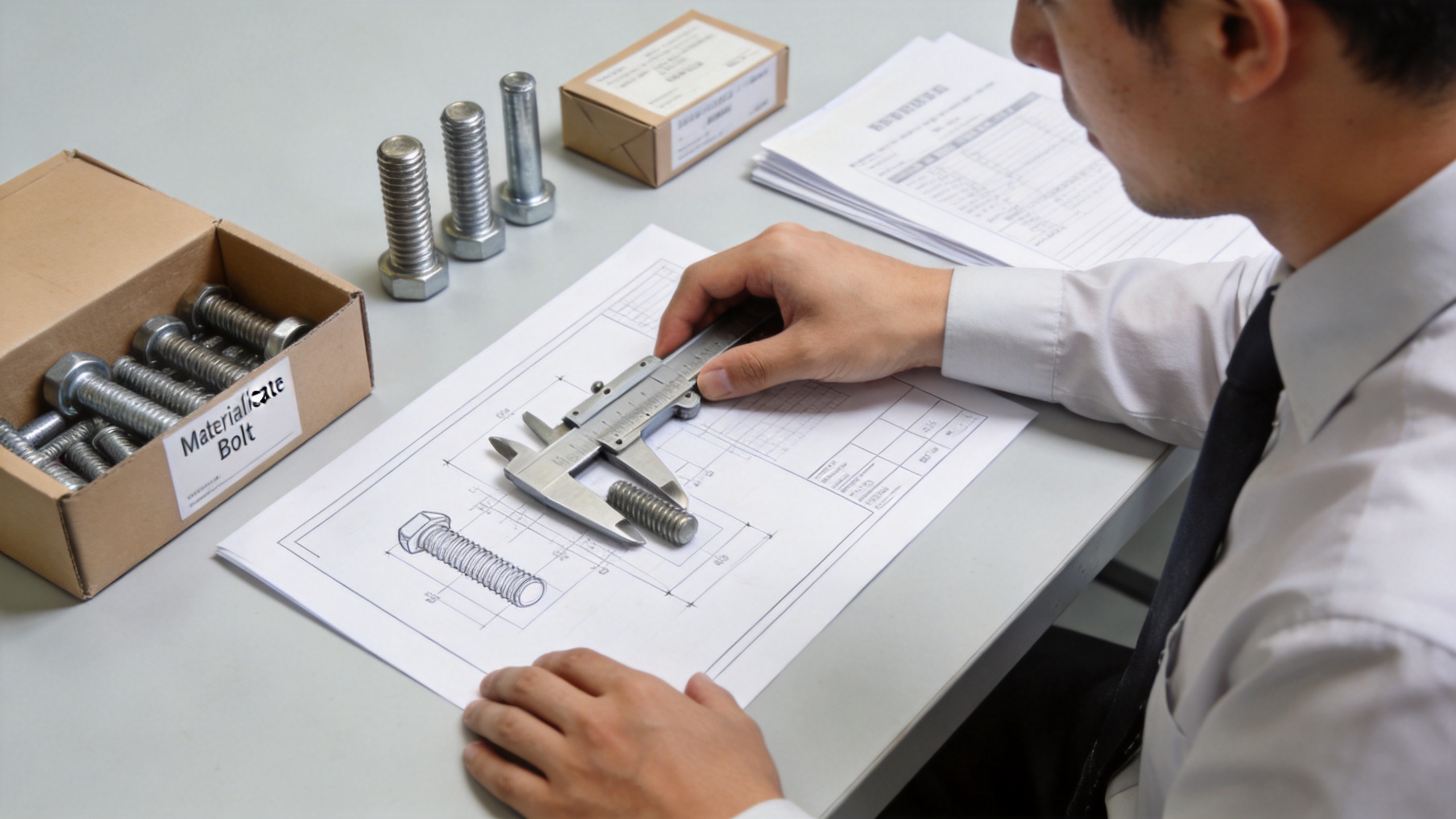
This is also where a buyer distinguishes a one-off bulk bolt purchase from a repeat program. For repeat items, include forecast quantity and release cadence. A manufacturer can then comment on tooling, material planning, batch sizing, and packaging in a way that a retail listing cannot.
Screen the bolt supplier before requesting a full production quote
Do not judge a bolt supplier only by a website photo or a price sheet. Use an early qualification call or questionnaire to learn whether the supplier understands the requested bolt family and whether its process can support the order. Ask what documents it can provide for the quoted item, how lots are identified, which dimensions are routinely checked, and how it handles a drawing revision.
For an export order, it is sensible to ask how the supplier will confirm language, units, standards, packing marks, and shipment documents. Qingdao Jeekuu Hardware Products Co., Ltd. describes a range covering bolts and related fasteners, export support, and inspection before shipment; buyers should still request order-specific confirmation rather than assuming every material, finish, document, or test applies to every item.
The same principle applies to customization. A manufacturer may be able to review special sizes, threads, or materials, but a buyer should obtain written confirmation of the drawing revision, approval sample, commercial terms, and agreed inspection points before a custom bolt wholesale order is released.
Use samples to test communication as well as parts
Samples are useful because they reveal more than physical dimensions. The sample stage tests whether the bolt manufacturer can interpret the RFQ, identify open questions, label parts clearly, and return documents that match the item. Compare the sample against the approved drawing or specification, not against memory or a product photo.
For critical bolts, define the sample review before testing begins. It may include thread gauging, head and length checks, visual finish review, marking review, hardness or material verification where relevant, and a document review. If a buyer needs a specific test method or acceptance plan, that request should be stated before sampling. A certificate without a traceable connection to the received lot has limited value.
Many procurement teams learn this after an avoidable delay: a technically acceptable sample does not prove that every later batch will be identical. For a recurring bulk bolt order, ask how production lots are controlled and how records follow the lot through packing and shipment.
Compare quotations on delivered risk, not unit price alone
Bulk pricing is valuable, but it is only one line in the total purchase cost. Compare quotes using the same quantity, material, finish, certificate scope, packing, trade term, and delivery assumption. If one quote leaves out washers, testing, labels, or export packing, it is not directly comparable with a quote that includes them.
| Comparison area | Buyer check | Why it matters |
|---|---|---|
| Technical match | Does every dimension, thread, material, and finish match the RFQ? | Prevents a low quote based on a different bolt. |
| Quality scope | Are inspection records, certificates, and traceability stated item by item? | Makes receiving checks practical. |
| Delivery basis | Are production time, packing, shipment point, and trade term clear? | Clarifies the schedule and handover of responsibility. |
| Change control | How will substitutions or drawing questions be approved? | Reduces undocumented changes after ordering. |
A bolt wholesale decision should account for the cost of sorting, rework, expedited replacement, and interrupted assembly if the wrong parts arrive. The exact impact depends on the order and application, so it is better to model the relevant risks than to promise a fixed saving.
Set a receiving plan before the shipment leaves
Set receiving checks while the order is still open. Depending on criticality, the receiving team may verify package labels and lot numbers, count quantities, inspect visible finish defects, measure key dimensions, gauge threads, review markings, and reconcile certificates with the shipment. For selected applications, hardness, coating thickness, or additional testing may also be appropriate under the buyer’s approved procedure.
Keep photos, records, and retained samples in a way that connects them to the purchase order and lot. If a discrepancy appears, clear evidence helps the buyer and bolt supplier identify whether the issue is a specification, production, packing, or handling problem. This approach is especially helpful where bolts will be installed across several work orders or shipped to multiple sites.
A practical path to a reliable bulk order
Start with the application and a complete RFQ. Shortlist manufacturers that can discuss the requested bolt type, documentation, inspection, and delivery basis in clear terms. Approve samples against written criteria, compare quotations on the same scope, and set lot-level receiving checks before production finishes. Those steps take more effort than selecting the first catalog result, but they give buyers a repeatable way to source bulk bolts with fewer unresolved assumptions.
If your team is preparing a new request for bolts, gather the drawing, expected quantity, material and finish requirements, destination, and document needs first. A focused RFQ gives both the buyer and manufacturer a sound basis for the next conversation.